

ASO vs SEO
Key takeaways
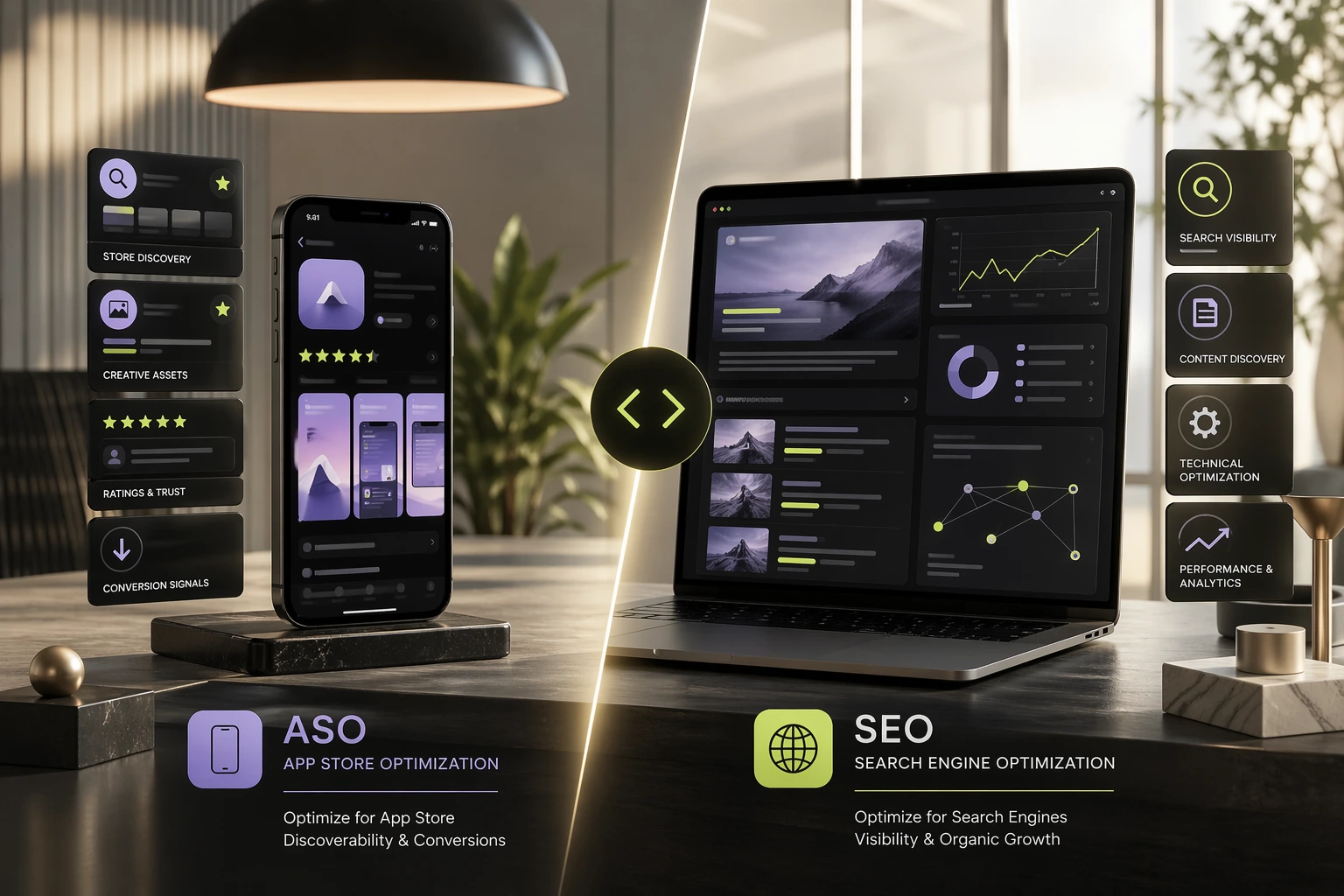
- ASO (App Store Optimisation) and SEO (Search Engine Optimisation) are distinct disciplines with different ranking systems, conversion environments, and measurement frameworks — treating them as one strategy underperforms both.
- ASO ranks inside curated app stores with limited surface area: title, subtitle, screenshots, and category dominate; off-store backlinks are largely ignored.
- SEO ranks across the open web with vast surface area: content depth, technical SEO, and link authority dominate; conversion happens off your own pages, not inside an OS chrome.
- Run ASO and SEO in parallel when your product has both an app and a web presence, but staff them as separate workstreams with their own KPIs and tooling.
App Store Optimisation (ASO) and Search Engine Optimisation (SEO) are distinct disciplines with different ranking systems, different conversion environments, and different measurement frameworks. Treating them as equivalent produces poor results in both channels.
The conflation of ASO and SEO is widespread in digital marketing literature and in briefs received from product teams. Both involve keyword research, metadata, and discoverability. Both affect how a product is found. But the underlying systems — app store ranking algorithms vs web search engine ranking algorithms — are architecturally different, and the optimisation work required for each reflects those differences. A strategy designed for one does not transfer to the other without material rework.
What ASO and SEO actually are
App Store Optimisation (ASO) is the practice of improving the discoverability and conversion rate of a mobile application within app stores — primarily Apple App Store and Google Play. ASO governs how an app appears in store search results, browse categories, and editorial features. The ranking algorithm weighs factors including: keyword relevance (title, subtitle, keyword field for iOS; title and long description for Android), install velocity, ratings count and recency, retention and engagement signals, and store-specific conversion metrics.
Search Engine Optimisation (SEO) is the practice of improving the discoverability of web pages in search engines — primarily Google, with secondary consideration for Bing and increasingly for AI-powered search interfaces. SEO governs how web pages appear in search results for informational, navigational, commercial, and transactional queries. The ranking algorithm weighs factors including: content relevance and semantic coverage, page experience signals (Core Web Vitals), backlink authority, technical accessibility, and structured data implementation.
The two disciplines share a common surface — keyword research methodology, competitive analysis approaches, and metadata quality — but the execution diverges immediately once you move beyond research into implementation. An ASO practitioner without iOS App Store Optimization experience cannot execute ASO by applying SEO knowledge. The reverse is equally true.
The conflation of ASO and SEO is widespread in digital marketing literature and in briefs received from product teams. Both involve keyword research, metadata, and discoverability. Both affect how a product is found. But the underlying systems — app store ranking algorithms vs web search engine ranking algorithms — are architecturally different, and the optimisation work required for each reflects those differences. A strategy designed for one does not transfer to the other without material rework.
Logic Grid Studio
Where they overlap and where they diverge
The overlap between ASO and SEO is genuine and useful, but it is narrower than it appears.

Store-specific mechanics
Apple App Store and Google Play have different indexing models, and optimisation approaches for each reflect those differences.
Apple App Store (iOS). Apple indexes: the app name (up to 30 characters), subtitle (up to 30 characters), and a dedicated keyword field (100 characters, comma-separated, not user-visible). The long description is not indexed for search. This means iOS ASO is fundamentally about keyword allocation: distributing the right terms across name, subtitle, and keyword field with no redundancy (repeated keywords do not improve ranking and waste allocation). Install velocity — the rate at which an app accumulates installs, particularly in the early period after release or a major update — is a significant ranking signal. Ratings and review recency have measurable ranking effects.
Google Play (Android). Google indexes both the short description (80 characters) and the long description (4,000 characters). This gives Android ASO more surface area for keyword targeting. However, keyword stuffing is penalised — the long description must read naturally. Google Play's ranking algorithm shows more similarity to Google Search's approach than Apple's does, likely due to the shared ML infrastructure. Android apps can also be indexed by Google Search and appear in web search results for branded and branded-adjacent queries.
A/B testing tooling. Both stores provide native A/B testing for app store listings. Apple's Product Page Optimization (PPO) allows testing icon, screenshots, and preview video with iOS 15+ users. Google Play's Store Listing Experiments allow similar testing. These tools are the primary lever for improving store listing conversion rate once baseline discoverability is established — conversion optimisation in stores is a distinct phase from keyword optimisation.
Conversion in different environments
The conversion environments of app stores and web search are structurally different, and the optimisation work for each reflects those structural differences.
App store product page conversion. A user discovering an app through store search sees: app icon, name, subtitle, ratings summary, and the first few screenshots before the fold. That above-the-fold experience — occupying approximately 3 to 4 seconds of consideration time — accounts for the majority of conversion decisions. The screenshot set must communicate the app's core value proposition, differentiator, and social proof within that constrained space. Preview video, if present, must deliver its key message in the first three seconds. Long description is rarely read unless the user has already decided to consider the app seriously.
Landing page conversion. Web search conversion happens across a full page with significantly more content real estate. Users arrive with varied intent — some information-seeking, some comparison-making, some ready to convert. The page must serve multiple intent states simultaneously. Proof elements (case studies, specific outcomes, credentials) carry more weight on landing pages than in stores, because users have time to read and have not already committed to a category (they are still evaluating options, not just selecting between apps in a category).
User intent at conversion point. App store users searching for a category ("expense tracker", "project management") have already decided they want an app — they are selecting which one. Web search users may be at any stage. This intent differential means store conversion friction is primarily between apps in the category, while web landing page conversion friction is also against the option of doing nothing or using an alternative that is not an app at all.
When to run ASO and SEO in parallel
Mobile-first products with both a consumer app and a web presence typically benefit from running ASO and SEO simultaneously — but the disciplines must be managed separately, with distinct measurement frameworks, to avoid attribution confusion.
The typical funnel architecture for mobile-first products: web search drives top-of-funnel awareness and consideration (informational content, category-level SEO, problem-framing content); app store search captures bottom-of-funnel intent from users who have already decided to find a solution in the app category. The two channels are complementary and sequential for many user journeys.
Measurement discipline is critical. ASO metrics — install rate, store conversion rate, keyword ranking in store search — are measured in App Store Connect and Play Console, not in web analytics. SEO metrics — organic sessions, ranking position, click-through rate — are measured via Google Search Console and web analytics. Attribution of installs to web-originated sessions requires deterministic (UTM + app deep link) or probabilistic (SKAdNetwork, referrer data) attribution infrastructure. Without this infrastructure, web and store performance data cannot be related, and combined reporting is misleading.
Logic Grid Studio's Digital Marketing & Growth work includes both ASO and SEO scoping, and the Services page covers how both fit within the studio's broader discoverability offering for product teams building in mobile-first environments.
Frequently asked questions
Can the same person own both ASO and SEO?
Operationally yes, but the disciplines reward different skills. ASO rewards conversion-rate optimisation against a fixed UI, screenshot iteration, and review management; SEO rewards content strategy, technical site health, and off-site link work. Splitting them once you exceed a couple of campaigns is the usual move.
Do ASO efforts help SEO indirectly?
Marginally. App store listings can rank for branded queries on the open web, and a strong app presence reinforces brand entity signals that influence SEO rankings. But the bulk of ASO outcomes (installs, store conversion) do not transfer to SEO metrics.
Which should I prioritise first — ASO or SEO?
Whichever surface drives revenue today. If installs and in-app revenue dominate, prioritise ASO; if web traffic and lead generation dominate, prioritise SEO. Run a 4–6 week measurement period before splitting investment.


Related services
 Let's scope your next system together.


0 Comments
Share your perspective
Questions, corrections, or commentary on this topic - we read everything. Your email address will not be published.