A six-language ticket site for one of the world's most famous landmarks
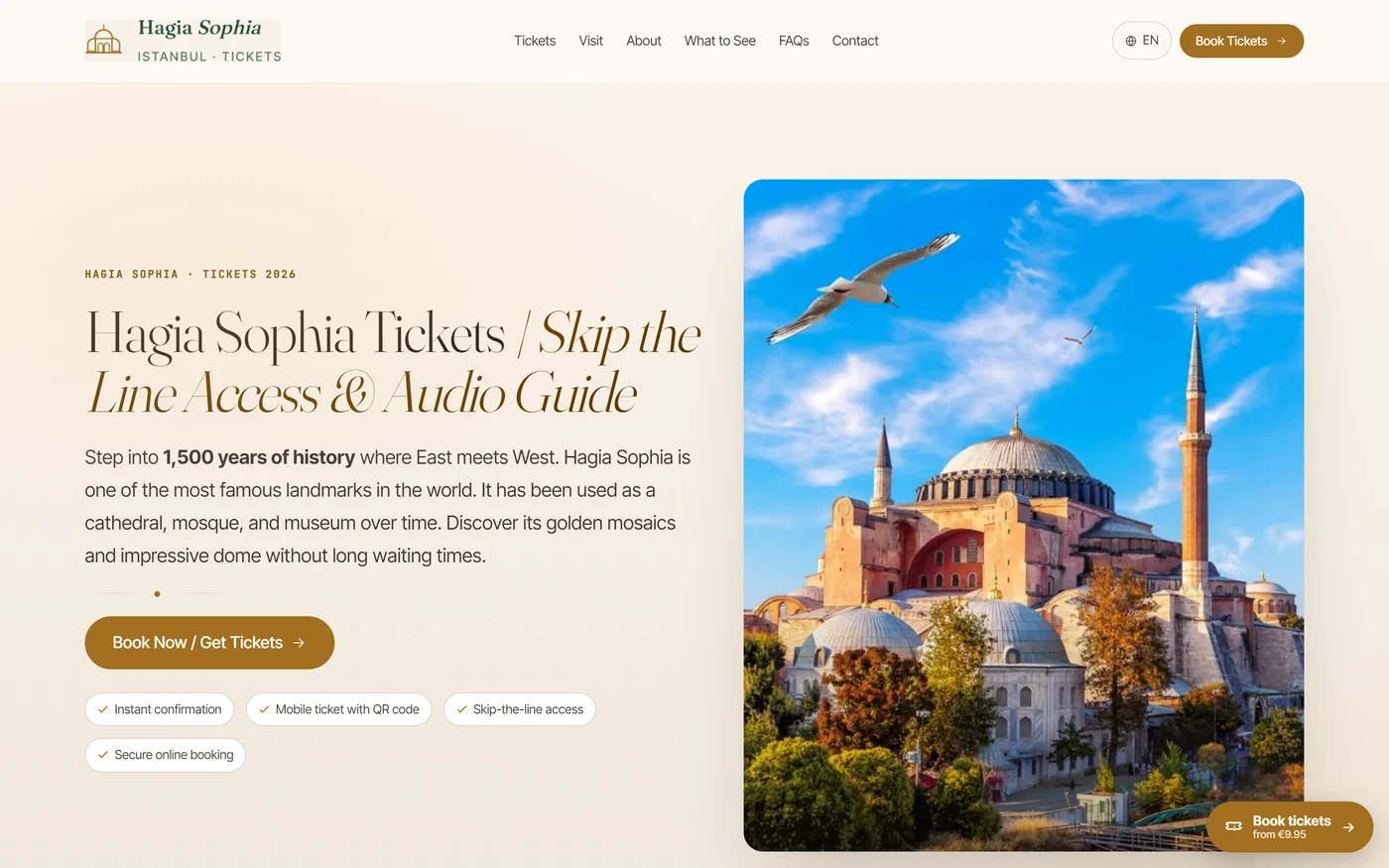
Hagia Sophia is 1,500 years of history where East meets West — cathedral, mosque and museum in turn — and one of the most famous landmarks on earth. Logic Grid Studio built hagiasophia-ticket.com from scratch: the from-zero front end, the skip-the-line booking experience, the visitor content and information architecture for the landmark, and a multilingual build in six languages — English, Deutsch, Español, Français, Italiano and 简体中文. On top of the build we laid the technical SEO foundation and the GEO/AEO structure that lets AI answer engines cite the pages cleanly — the right shape for a query space full of travellers asking how to visit, what it costs and what to see inside.
The situation
Hagia Sophia is one of the most famous landmarks in the world: 1,500 years of history at the centre of the Byzantine and Ottoman empires, a 56-metre dome, golden Byzantine mosaics, the Mihrab and the Wishing Column, and a UNESCO World Heritage listing. It is also one of the most-visited, with travellers arriving from dozens of countries, each in their own language, all asking the same practical questions before they go — how do I get tickets, how do I skip the line, what does it cost, what is the dress code, what is there to see inside. A landmark of that draw needs a ticket site that meets every one of those visitors in their own language and answers them before they bounce to a competitor. The brief was not a brochure. It was a working, multilingual booking site for a global landmark, built to convert the world's curiosity into a planned visit.
Why they came to us
Building a site like this is not three separate jobs handed to three vendors. The from-scratch front end is a build problem — a fast, trustworthy booking experience that works across phones and six writing systems including 简体中文. The visitor content and information architecture are a product problem — how to organise tickets, visit logistics, what-to-see and FAQs so a stranger lands and immediately knows what to do. And being found is an SEO and GEO problem — both classic search ranking and the newer question of whether AI answer engines will cite these pages when someone asks them how to visit Hagia Sophia. Those three move together: the way the pages are built shapes how they're crawled, and the way they're structured shapes whether they're quoted. Hagia Sophia Tickets came to Logic Grid Studio for a partner who could own all of it — build, content, technical SEO and GEO — rather than stitching a developer, a copywriter and an SEO around a site none of them owned whole.
Constraints
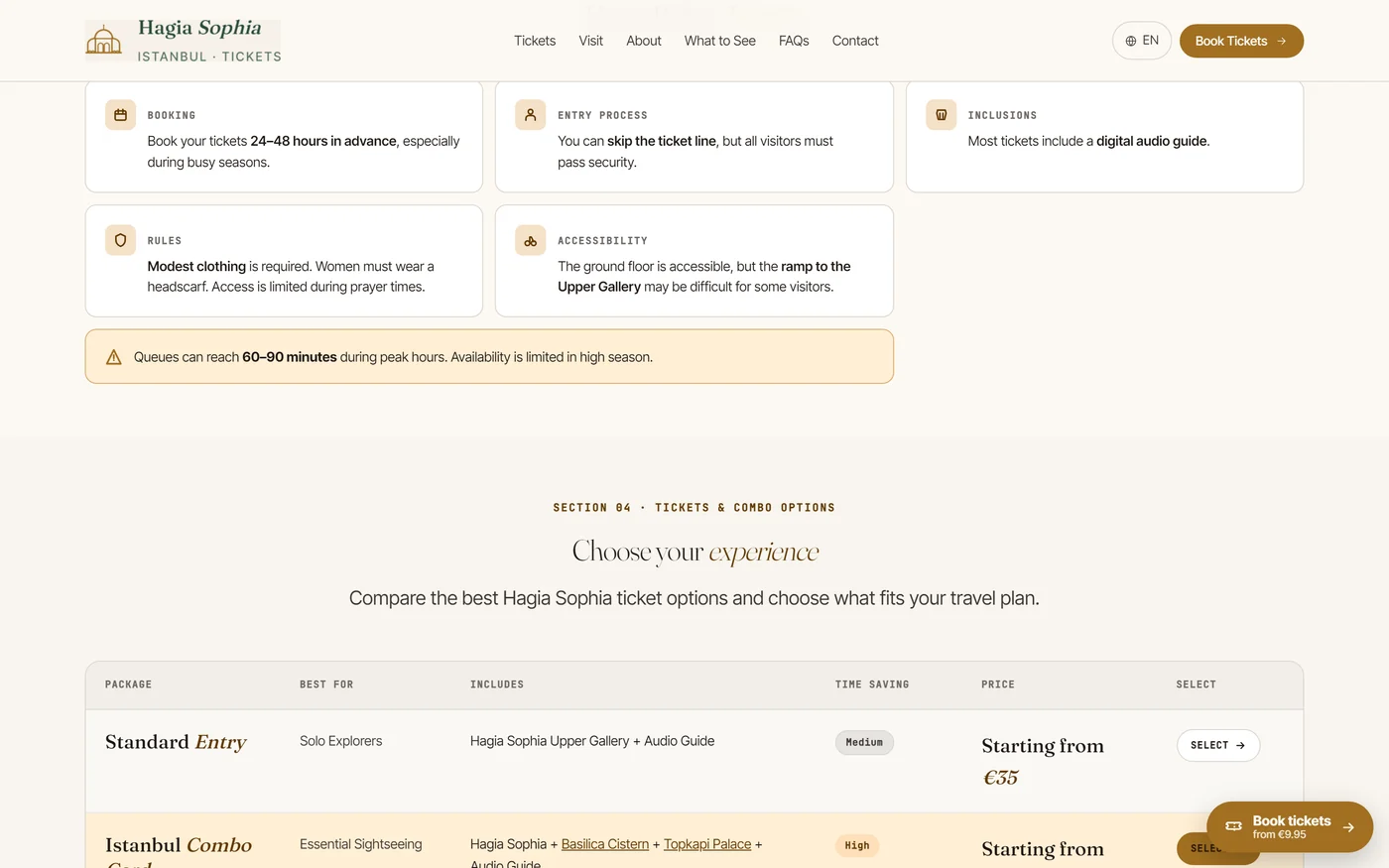
This was a from-zero build that had to ship genuinely multilingual on day one — six full languages, English, Deutsch, Español, Français, Italiano and 简体中文, including a non-Latin script — with each locale a first-class experience rather than a machine-translated afterthought. The booking flow had to make the site's core promise real: visitors can skip the ticket line, but everyone still passes security, so the experience had to set that expectation honestly while making the purchase fast and obvious. The content had to carry real visitor logistics — book 24–48 hours ahead in busy seasons, modest dress required with a headscarf for women, limited access during prayer times, the Upper Gallery ramp that some visitors find difficult — without burying the path to a ticket. And because this is a fiercely contested travel query space, the technical SEO and GEO foundation had to be built into the architecture from the first commit, not retrofitted, so every one of the six locales was crawlable and citable in its own right.
What we owned
Logic Grid Studio owned the whole thing — build, content, technical SEO and GEO — end to end. We built hagiasophia-ticket.com from scratch: the front end, the skip-the-line booking experience, and the navigation that runs from Tickets and Visit through About, What to See, FAQs and Contact. We designed the information architecture and wrote the visitor content for the landmark — Why Visit, Know Before You Go, the Choose Your Experience ticket comparison, What to See Inside (the Central Dome, the Byzantine Mosaics, the Mihrab, the Wishing Column, the Imperial Gate and more), Plan Your Visit, nearby landmarks, and the FAQ block. We delivered all of it in six languages — English, Deutsch, Español, Français, Italiano and 简体中文 — as a genuine multilingual architecture. And we laid the technical SEO foundation and the GEO/AEO structure: clean, crawlable pages with the metadata, headings and answer-shaped content that let both search engines and AI answer engines understand and cite the site across every locale.
Our approach
We started from the visitor and worked outward. The page architecture answers the journey in order — Why Visit to earn attention, Know Before You Go for the honest logistics, Choose Your Experience to compare tickets, What to See Inside to build anticipation, Plan Your Visit to close — so a stranger from any country lands and is carried straight to a booking. The skip-the-line experience was built to be fast and unambiguous, with the security-check reality stated plainly rather than hidden, because a clear promise converts better than an oversold one. Multilingual was treated as architecture, not translation: six locales including 简体中文 built as parallel first-class experiences so every visitor reads native content. The technical SEO foundation went in from the first commit — crawlable structure, clean metadata and headings tuned to how people actually search for Hagia Sophia tickets. And GEO/AEO shaped the content itself: the FAQ block and the Know-Before-You-Go and What-to-See sections were written as direct, well-structured answers, so when a traveller asks an AI engine how to visit Hagia Sophia, the pages are shaped to be quoted.
The outcome
Hagia Sophia Tickets went from nothing to a complete, six-language ticket site for one of the most famous landmarks on earth — built, written, and tuned for search and AI answer engines by a single partner. A traveller arriving in any of six languages — English, Deutsch, Español, Français, Italiano or 简体中文 — lands on a page that speaks to them natively, learns what to see inside, gets the honest logistics on dress code, prayer times and the 24–48-hour booking window, compares ticket options, and skips the line through a booking flow built for exactly that. The technical SEO foundation means each locale is crawlable and competitive in a crowded travel query space, and the GEO/AEO structure means the pages are shaped to be cited when someone asks an AI engine how to visit. What the client has is not a template or a single-language landing page but a from-scratch multilingual landmark booking site, owned end to end — build, content, SEO and GEO — behind one simple job: turn the world's curiosity about Hagia Sophia into a booked, well-prepared visit.
Frequently asked questions
What did Logic Grid Studio do for Hagia Sophia Tickets?
Logic Grid Studio built hagiasophia-ticket.com from scratch and owned the project end to end — the from-zero front end, the skip-the-line booking experience, and the visitor content and information architecture for the landmark, from Why Visit and Know Before You Go through the ticket comparison, the What to See Inside guide and the FAQs. On top of the build we laid the technical SEO foundation and the GEO/AEO structure that let both search engines and AI answer engines crawl, understand and cite the pages. The whole thing was delivered in six languages: English, Deutsch, Español, Français, Italiano and 简体中文.
What languages does the site support, and how was the multilingual build done?
The site ships in six languages — English, Deutsch, Español, Français, Italiano and 简体中文 — including a non-Latin script. It was built as a genuine multilingual architecture, with each locale a first-class experience and native visitor content rather than a machine-translated layer bolted onto an English site. Every section — tickets, visit logistics, what to see inside the landmark, and the FAQs — and the whole booking flow is delivered in all six languages, so a traveller from any of those markets reads and books in their own language.
What does the skip-the-line booking experience cover?
The site is built around skip-the-line access: visitors can skip the ticket line, and the booking flow makes choosing and buying the right ticket fast and clear. Logic Grid Studio designed the Choose Your Experience comparison and the surrounding Know Before You Go and Plan Your Visit content so the promise is set honestly — everyone still passes a security check, modest dress is required with a headscarf for women, access is limited during prayer times, and booking 24–48 hours ahead is advised in busy seasons — all woven into the build rather than buried.
Why does the SEO and GEO work matter for a landmark ticket site?
Hagia Sophia is one of the most famous landmarks in the world, and ticket searches are a fiercely contested travel query space. The technical SEO foundation Logic Grid Studio built makes each of the six locales crawlable and competitive, while the GEO/AEO structure — answer-shaped FAQs and clearly organised visit and what-to-see content — shapes the pages to be cited by AI answer engines when a traveller asks how to visit Hagia Sophia. Because the build, the content, the technical SEO and the GEO were owned by one partner, those signals were designed into the architecture from the first commit rather than retrofitted later.
Related services
Let's scope your next system together.