

A football app that turns live matches into the one alert you actually want
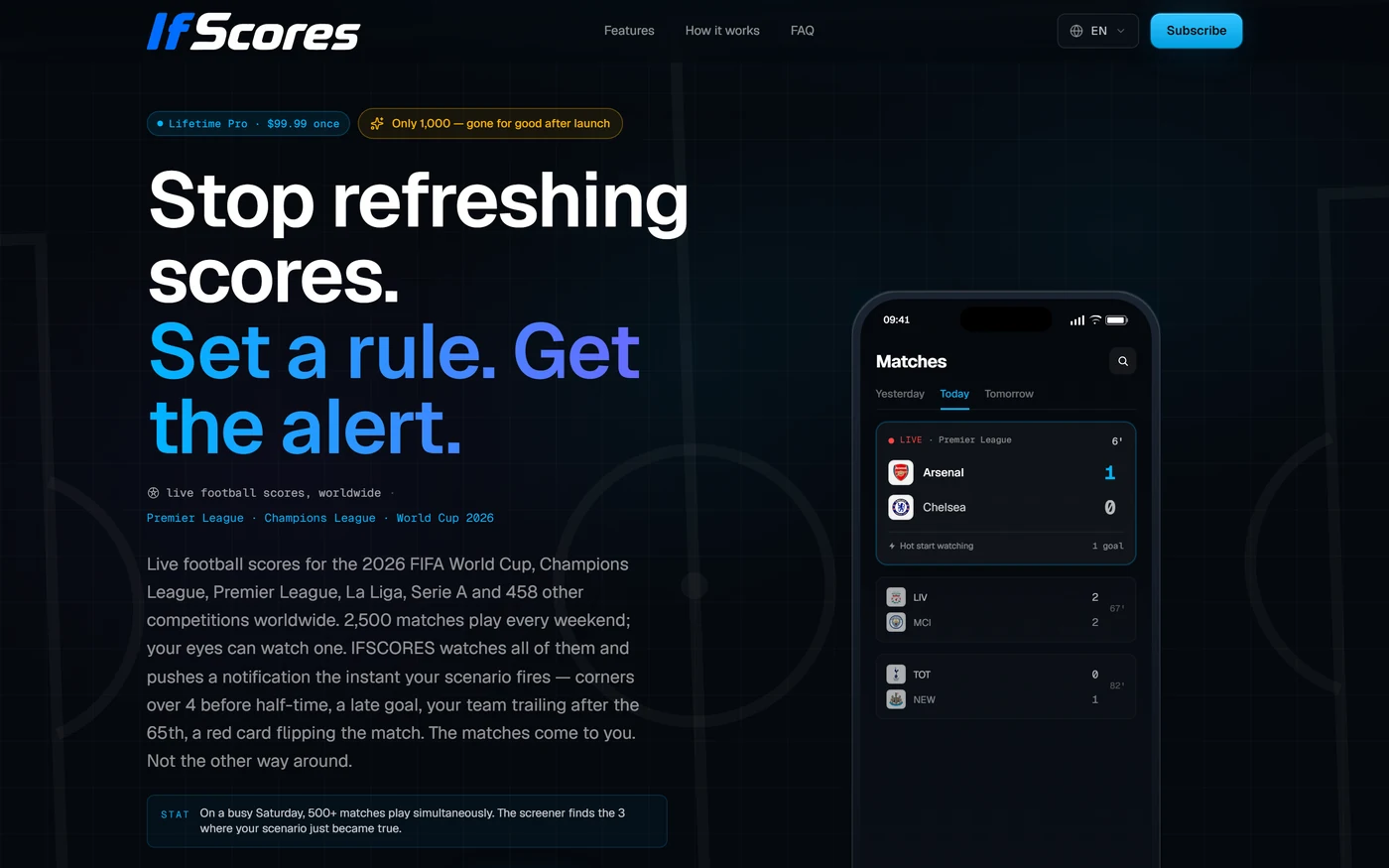
IFSCORES lets a fan describe a moment in plain language — a late goal, a red card, their team trailing after the 65th minute — and get pinged the second it happens, across 463 competitions. Logic Grid Studio designed and built the mobile app behind it: the no-code visual rule builder, the real-time alert engine, and the native iOS and Android experience that carries an on-pitch event to a lock screen in under eight seconds.
The situation
IFSCORES is built on a simple promise: stop refreshing scores, set a rule, get the alert. Instead of watching one match and missing five, a fan describes the moment they care about — a late goal, a red card, a team trailing after the 65th minute, more than four corners before half-time — and IFSCORES watches every match for them, pinging the instant the scenario fires. Behind that promise sits a genuinely hard real-time product: live football across 463 competitions, from the 2026 World Cup and the Champions League down to lower-tier leagues, with 2,500 matches every weekend and over 500 playing at once on a busy Saturday. The product needed a mobile app that makes that power feel effortless — something a non-technical fan can pick up and turn into a personal alerting engine without reading a manual — while staying fast, private and reliable enough that a missed or late notification is never an option.
Why they came to us
Building IFSCORES was never three separate jobs that could be handed to three vendors. The visual rule builder is a product-design problem — how do you let someone compose a multi-condition rule from dropdowns without it ever feeling like programming? The alert engine is a real-time systems problem — how do you evaluate hundreds of live matches against thousands of personal rules and deliver the right push to the right phone in seconds? And the iOS and Android apps are a native-experience problem — how do you make all of that feel instant and trustworthy on a lock screen. IFSCORES came to Logic Grid Studio because those three problems are one product: the UX, the engine and the native apps have to be designed together or the promise breaks. They needed a partner who could own the whole thing — design, build and ship — rather than stitching a designer, a backend shop and two mobile contractors around a real-time core nobody owned end to end.
Constraints
The app had to ship native on both iOS and Android from day one, and it had to feel instant: the median path from an on-pitch event to an alert on the lock screen had to land in under eight seconds, with a real-time API holding sub-300ms p95 latency and a 99.9% uptime target behind it. It had to scale to the real shape of football — 463 competitions, 2,500 matches a weekend, 500-plus live at once — without ever sending a fan the wrong alert or a stale one. The rule builder had to stay genuinely no-code: six steps, all dropdowns, up to five conditions, time windows, league filters and alert types, composable by someone who has never written a line of logic. And it had to be private by default — no Facebook Pixel, no Google Analytics, no third-party ad networks, no tracking pixels at all — which rules out the off-the-shelf analytics and attribution most apps lean on and puts the burden of reliability entirely on the engineering.
What we owned
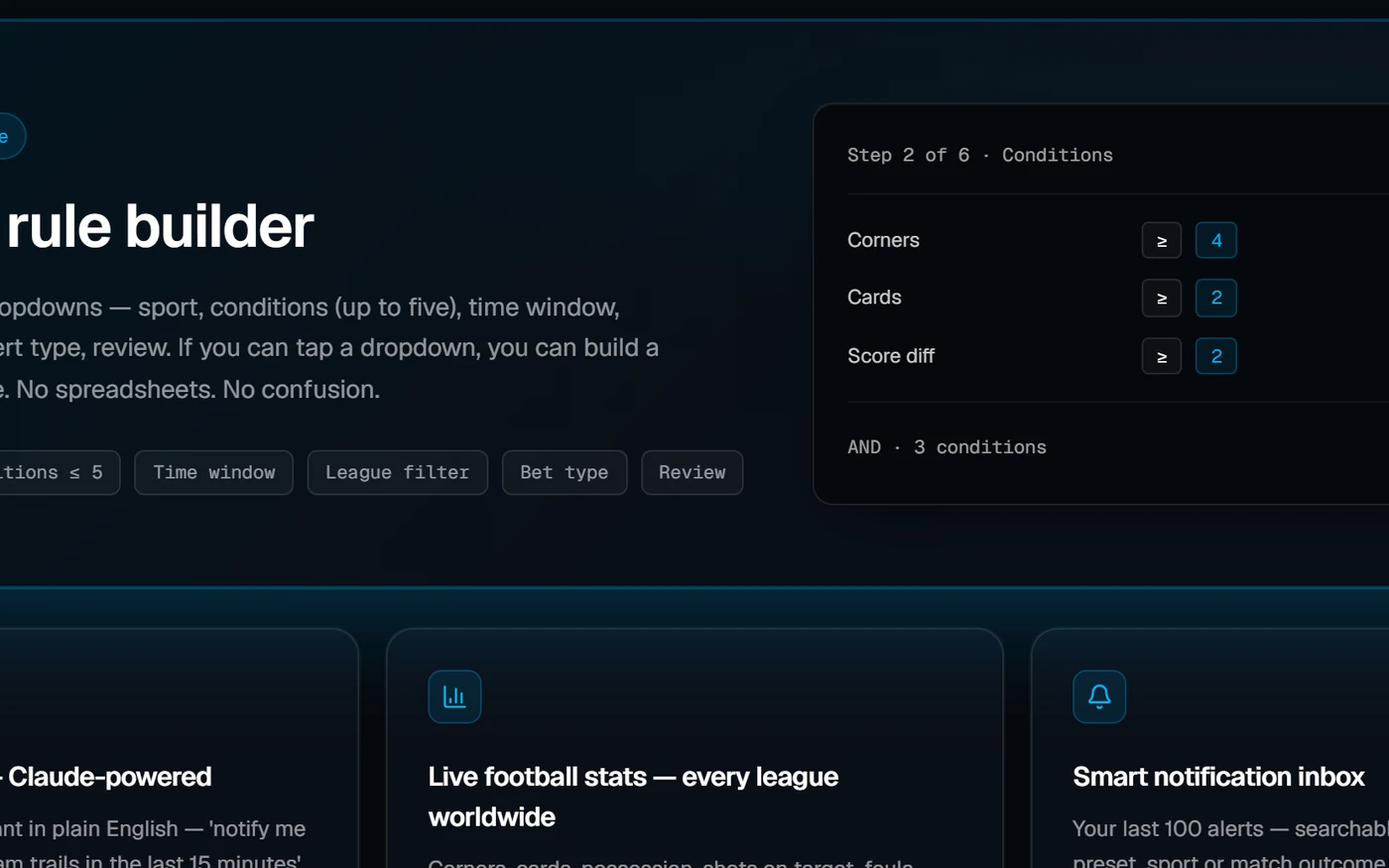
Logic Grid Studio owned the IFSCORES mobile app end to end — design and build, both platforms. We designed the visual rule builder so that composing a personal alert is a six-step, all-dropdown flow — sport, conditions, time window, league filter, alert type, review — that a fan can finish in under a minute and never once feel like coding. We built the native iOS and Android apps around it: the live match views, the searchable inbox of a fan's last hundred alerts, and the lock-screen notifications that are the whole point of the product. We owned the real-time layer that makes those notifications trustworthy — evaluating live matches against personal rules and delivering the push in seconds — and we built it to a privacy-first standard, with no tracking pixels, no third-party analytics and no ad networks anywhere in the app. We also shipped the AI-assisted on-ramp: a fan can describe what they want in plain English and have a ready-to-run preset drafted for them, lowering the very first step from a blank rule to a working one.
Our approach
We started from the moment the app exists to create — the alert — and worked backwards. The rule builder was designed as plain conversation rendered as dropdowns: every choice is a word a fan already uses about football, so a five-condition rule reads like a sentence rather than a query. To make the first rule effortless we added a Claude-powered draft step, where a fan types what they want in plain English and gets a working preset back to tweak rather than a blank canvas — an AI on-ramp into a no-code tool. Underneath, the real-time engine was built API-first so the same evaluation core feeds both native apps identically; the push pipeline was tuned for the eight-second budget end to end, because a sports alert that arrives late is worse than no alert at all. Privacy shaped the architecture rather than being bolted on: with no third-party analytics or tracking pixels allowed, reliability and instrumentation had to be earned in our own code and tested against the real load of a weekend football calendar — hundreds of matches live at once, evaluated continuously. The native apps were then designed to make all of that disappear, so the product feels less like software a fan operates and more like a knowledgeable friend who only texts when something actually happens.
The outcome
IFSCORES went from a promise to a shipped product on both app stores: a fan stops refreshing scores, spends under a minute composing a rule from plain-language dropdowns, and from then on hears from the app only when their exact moment happens — a late goal, a red card, their scenario firing somewhere in 463 competitions — delivered to the lock screen in under eight seconds. The visual rule builder turns a real-time data problem into something that feels like texting a friend, the AI draft step removes the blank-page friction of the very first rule, and the privacy-first build means none of it costs the fan their data — no tracking pixels, no ad networks, nothing watching them while they watch the football. What the client has now is not a prototype or a single-platform experiment but a native iOS and Android app sitting on a real-time engine that holds up under a full weekend of football — the complete product, designed and built end to end, behind the line stop refreshing scores, set a rule, get the alert.
Frequently asked questions
What did Logic Grid Studio do for IFSCORES?
Logic Grid Studio designed and built the IFSCORES mobile app end to end on both iOS and Android — a real-time football-alerts product that lets a fan describe a moment in plain language, such as a late goal, a red card, or their team trailing after the 65th minute, and get pinged the instant it happens across 463 competitions. The work spanned the no-code visual rule builder, the real-time alert engine, and the native iOS and Android experience that carries an on-pitch event to a lock screen in under eight seconds.
What exactly did Logic Grid Studio own and deliver on this project?
Logic Grid Studio owned the app end to end — design and build, both platforms — delivering the six-step, all-dropdown visual rule builder a fan can complete in under a minute, the native iOS and Android apps with live match views and a searchable inbox of the last hundred alerts, and the real-time layer that evaluates live matches against personal rules and delivers the push in seconds. It also shipped a Claude-powered AI on-ramp, where a fan describes what they want in plain English and gets a ready-to-run preset drafted for them instead of a blank rule.
What technology and services went into the IFSCORES app?
The build combined product design, native mobile development, and real-time backend engineering: native iOS and Android apps built on a single API-first real-time alert engine and push pipeline, so the same evaluation core feeds both platforms identically. It was engineered to be private by default — no Facebook Pixel, no Google Analytics, no third-party ad networks and no tracking pixels at all — and includes a Claude-powered draft step that turns plain-English requests into working alert presets.
Why did IFSCORES choose to work with Logic Grid Studio, and what was the outcome?
IFSCORES came to Logic Grid Studio because the rule builder, the alert engine, and the native apps are really one product — the UX, engine and apps have to be designed together or the promise breaks — so they needed a partner who could own design, build and ship rather than stitching together a designer, a backend shop and two mobile contractors. The outcome was IFSCORES going from a promise to a complete, shipped product on both app stores: native iOS and Android apps on a real-time engine that holds up under a full weekend of football, scaling to 463 competitions and 2,500 matches a weekend while delivering alerts to the lock screen in under eight seconds. The app is live at https://ifscores.com.
Related services
Let's scope your next system together.