

A Google-style site for a SaaS that turns table QRs into Google reviews
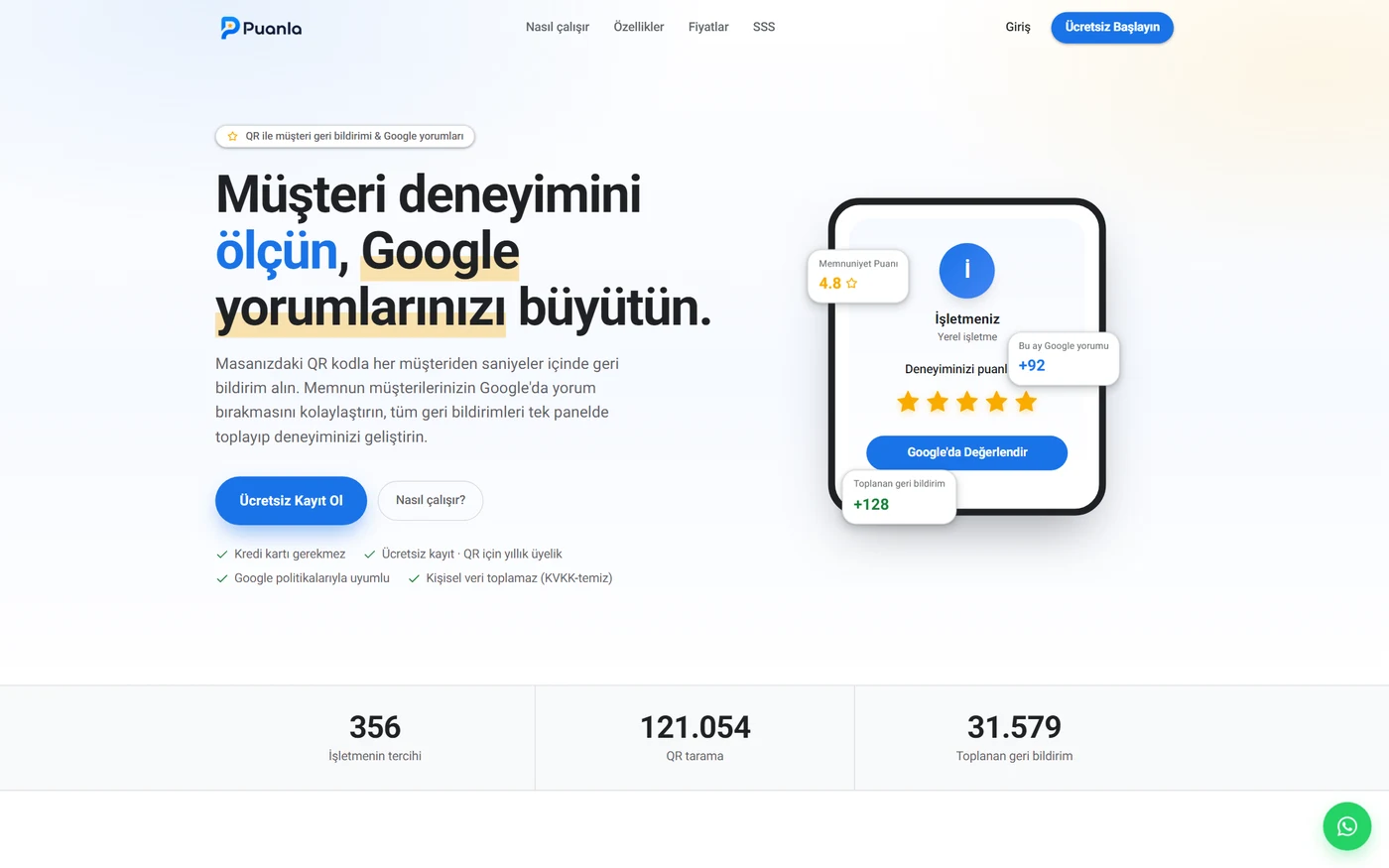
Puanla is a Turkish SaaS with one clear promise for local businesses: measure customer experience, grow your Google reviews. A QR code on the table captures feedback from every customer in seconds, makes it easy for happy customers to leave a Google review, and collects everything in one panel — Google-policy compliant, with no personal data collected. Logic Grid Studio built puanla.app from scratch on Next.js, in the deliberately Google-style interface the product itself promises — white, Roboto, the #1a73e8 blue — with the information architecture, the pricing page and the free-signup flow. On top of the build we delivered the technical SEO and the GEO layer, including a 13-question FAQPage schema shaped for AI answer engines.
The situation
Puanla is a Turkish SaaS for local businesses — cafés and restaurants, barbers and hairdressers, beauty salons, dental clinics, hotels and retail — that puts a QR code on the table and captures customer feedback in seconds. The platform makes it easy for happy customers to leave a Google review, while improvement ideas reach the business through a private feedback channel and everything lands in one panel. Its positioning is deliberate and strict: not a review-gating tool, Google-policy compliant, and KVKK-clean — the rating flow collects no personal data.
Why they came to us
A self-serve SaaS like this is sold by its website: the site has to explain the product in one pass, publish the price without asterisks, and carry a business owner from a search result to a free signup. Puanla needed that site built from scratch — and it needed to be findable both in classic search and in the AI answer engines where owners ask whether requesting reviews is even allowed, a question Puanla's own FAQ answers. Build, SEO and GEO shape each other, so we delivered all three as a single engagement.
Constraints
The launch was single-language Turkish, so every page had to work as the only version — no fallback locale, one market, one reading. The positioning demanded care: Puanla is not a review-filtering tool, and the site had to say so plainly while staying inside Google's policies and the KVKK-clean stance of collecting no personal data. And the pricing model — one annual package at ₺5.000/year + KDV per branch, a 10% discount on every branch for businesses with two or more branches (₺4.500/year + KDV each), no monthly plan — had to be communicated clearly enough that a visitor never has to ask.
What we owned
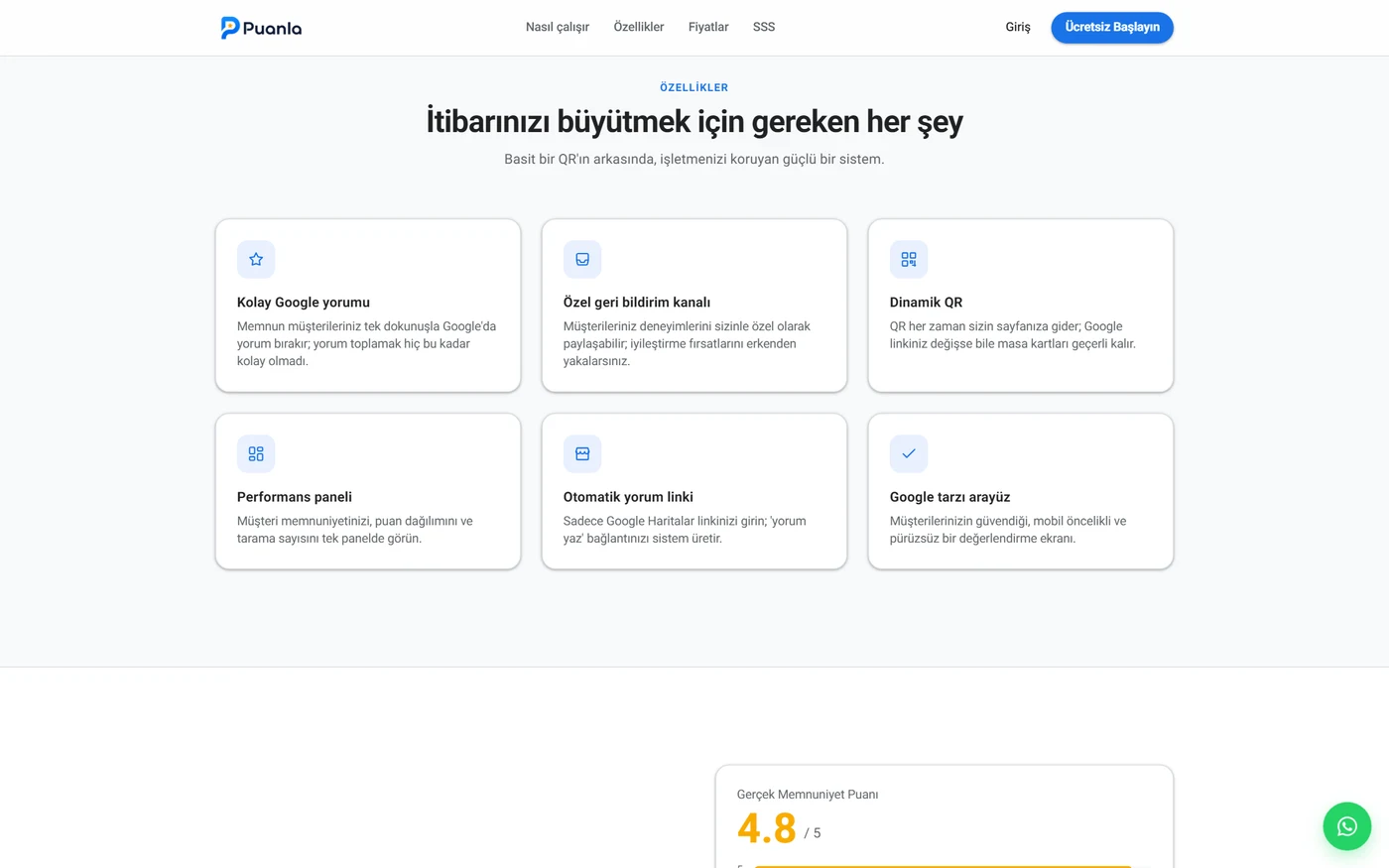
We owned the whole delivery: a from-scratch build on Next.js, the information architecture — Nasıl çalışır, Özellikler, Fiyatlar, SSS — and the Google-style design system the product itself promises. On top of the build we ran the technical SEO — crafted titles and meta descriptions, sitemap.xml and robots.txt — and the GEO/AEO layer, including a 13-question FAQPage schema in JSON-LD. We also built the conversion paths: the Giriş and Ücretsiz Başlayın CTAs, signup at /kayit, and a WhatsApp bubble for direct questions.
Our approach
We designed the interface the way the product describes itself — Google-style: white, Roboto, the #1a73e8 blue — so the site speaks the same language as the experience the customer's customer will see. The narrative runs in the product's own three steps — scan the QR, share the experience, review & feedback — with trust ticks under the hero (no credit card, Google-policy compliant, KVKK-clean) handling objections up front. Pricing became a single clear package instead of a plan matrix, and the GEO work was FAQ-driven: thirteen questions written the way business owners actually ask them, from how Google reviews affect Maps ranking to whether asking for a review is within Google's rules, all marked up as FAQPage schema.
The outcome
Puanla now runs on a site that carries its feedback-to-review flow end to end: a business owner lands, reads the three steps, sees the single price and signs up free at /kayit without a credit card. Search engines get crafted metadata, a sitemap and robots.txt; AI answer engines get thirteen answer-shaped questions in FAQPage schema, ready to quote. And the positioning boundary — policy-compliant review growth, not review gating — is stated on the page and in the schema, so wherever an answer gets assembled, the correct positioning is there to be quoted.
Frequently asked questions
What did Logic Grid Studio do for Puanla?
We built puanla.app from scratch — a Next.js build with the information architecture running Nasıl çalışır, Özellikler, Fiyatlar and SSS, the Google-style design system, the pricing page and the free-signup flow at /kayit. On top of the build we delivered the technical SEO — crafted titles and meta descriptions, sitemap.xml, robots.txt — and the GEO/AEO layer, including a 13-question FAQPage schema in JSON-LD. One partner owned the build, the SEO and the GEO together.
Why does the Puanla site look like Google?
Deliberately. A Google-style interface is one of Puanla's own listed product features — the rating screen its customers' customers see is mobile-first and Google-familiar — so the marketing site was built in the same language: white surfaces, Roboto, the #1a73e8 blue. The site demonstrates the product's design promise instead of merely describing it.
How was the GEO work done on puanla.app?
FAQ-driven. We wrote thirteen questions the way business owners actually ask them — how Google reviews affect local Maps ranking, whether asking a customer for a review is within Google's rules, whether Puanla is a review-filtering tool (it is not) — and marked them up as FAQPage JSON-LD, alongside crafted metadata, sitemap.xml and robots.txt. That gives AI answer engines quotable, answer-shaped content and builds the product's compliance positioning into the machine-readable content itself.
How were pricing and signup structured on the site?
Around one number and one action. Puanla sells a single annual package — ₺5.000/year + KDV per branch, 10% off every branch for businesses with 2+ branches, no monthly plan — so the pricing page states it plainly, with setup and QR card design free. Signup is free with no credit card required, the Ücretsiz Başlayın CTA leads to /kayit, and a WhatsApp bubble handles direct questions.
Related services
Let's scope your next system together.