A six-language ticket site for one of Istanbul's most-searched landmarks
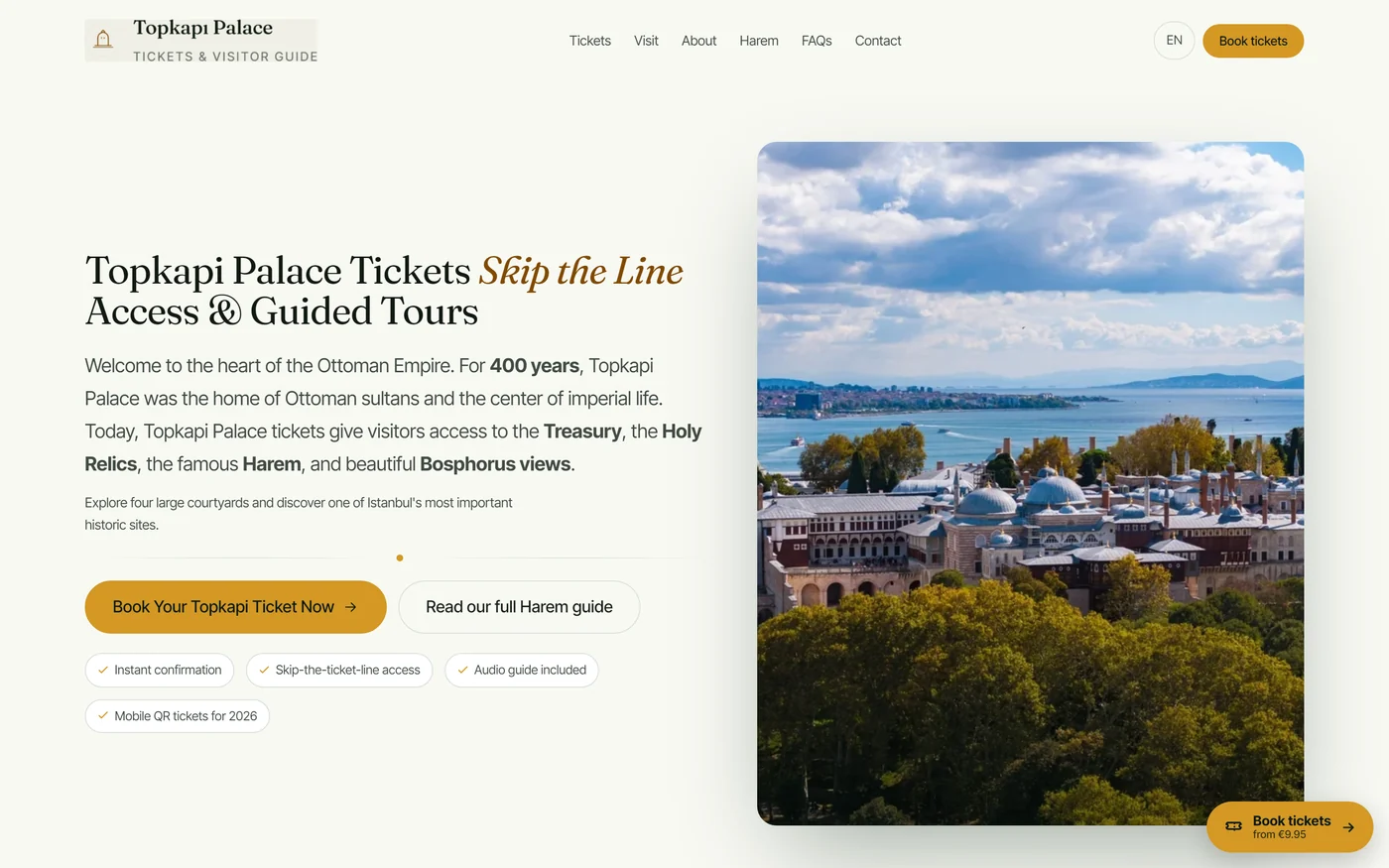
Topkapı Palace was the home of Ottoman sultans for four hundred years, and today it is one of the most-booked stops in Istanbul. topkapipalace-ticket.com is the site travellers land on to plan and book that visit — skip-the-line Palace and Harem tickets, what to see inside, opening hours, the Treasury and the Holy Relics. Logic Grid Studio built it from scratch: the multilingual architecture across English, Deutsch, Español, Français, Italiano and 简体中文, the skip-the-line booking experience, the content and information architecture for the landmark, and the technical SEO and GEO foundation that lets both search engines and AI answer engines find and cite it.
The situation
Topkapı Palace sits near the top of every Istanbul itinerary: the heart of the Ottoman Empire for four hundred years, four great courtyards, the Imperial Treasury with the Spoonmaker's Diamond, the famous Harem and the Holy Relics. That demand makes the ticket-booking query space ferociously competitive — a traveller searching how to visit Topkapı meets resellers, aggregators and official channels all at once, in whatever language they happen to think in. A site that wants to win that visitor cannot be a single English brochure. It has to greet a German family, a Spanish couple and a Chinese tour group each in their own language, answer the practical questions before they are asked — the palace is closed on Tuesdays, the Harem needs a separate ticket, you need two to three hours inside — and make booking the obvious next step rather than a leap of faith. The brief was to build exactly that destination from nothing and make it findable in a crowded market.
Why they came to us
Standing up a landmark ticket site that actually performs is not three jobs handed to three vendors. The build is an engineering and design problem — a fast, trustworthy site with a booking flow that converts a curious reader into a confirmed visit across six languages. The content and information architecture is an editorial problem — deciding what a first-time visitor needs to know about Topkapı, how the Palace, Visit, About, Harem and FAQ sections fit together, and how the same structure repeats cleanly in every language. And discoverability is its own discipline — technical SEO so search engines can crawl and understand every localized page, and GEO so the pages are structured to be quoted by the AI answer engines travellers increasingly ask first. On a multilingual ticket site those move together: the language architecture shapes the SEO, the content shapes what an AI can cite, the booking UX shapes whether any of it pays off. The client needed one partner to own all of it rather than stitch a developer, a copywriter and an SEO around a core no one held whole.
Constraints
The site had to ship in six languages from the start — English, Deutsch, Español, Français, Italiano and 简体中文 — which means six versions of every page, every section and every booking step, all kept in step so no language is a second-class afterthought. It had to be built from scratch, so there was no template to inherit and no existing content or URLs to preserve — every page, every signal and every line of the information architecture was a decision. The booking experience had to make skip-the-line Palace and Harem tickets the clear, low-friction path, because a landmark ticket site only earns its place by converting intent into a booking. The factual guidance had to be correct and genuinely useful — closed on Tuesdays, separate Harem ticket, two to three hours inside, security at the main gate — because a wrong detail on a ticket site costs a real visitor a real day. And the SEO and GEO foundation had to hold across all six localized trees at once, in one of the most contested query spaces in travel.
What we owned
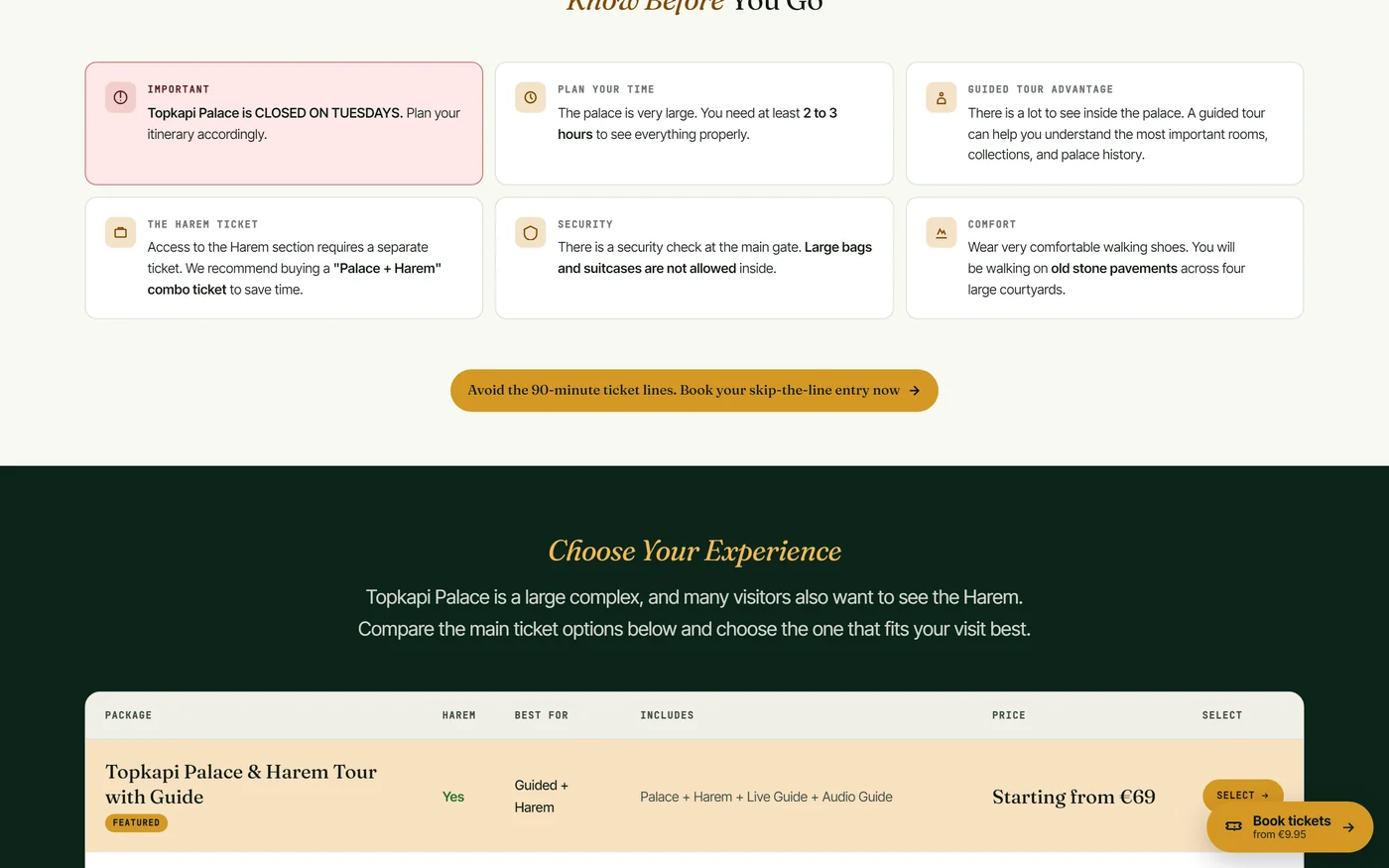
Logic Grid Studio owned the whole thing end to end — build, content, and discoverability. We built topkapipalace-ticket.com from scratch: the multilingual architecture spanning English, Deutsch, Español, Français, Italiano and 简体中文, with every page, section and booking step rendered cleanly in all six. We designed the skip-the-line booking experience that turns a reader into a confirmed Palace or Harem visit, and the Choose-Your-Experience section that lets a visitor pick the right ticket. We owned the content and information architecture for the landmark — the Why Visit, Know Before You Go, What to See Inside, Plan Your Visit and FAQ sections — structured so a first-time visitor finds what they need and the same skeleton repeats across every language. And we owned the technical SEO foundation — crawlability, indexation and clean structure across all six localized trees — alongside the GEO work that structures each page to be understood and cited by AI answer engines, so the site shows up whether a traveller searches the old way or simply asks an assistant.
Our approach
We treated the site as one multilingual system, not a stack of translations. The information architecture came first: we decided what a visitor genuinely needs to decide a Topkapı trip — why it is worth it, what to know before going, which ticket to choose, what to see inside, how to plan the day — and laid that out as a single skeleton (Tickets, Visit, About, Harem, FAQs, Contact) that every one of the six languages inherits, so a German and a Chinese visitor get the same well-structured experience in their own words. The booking UX was built around the real decision a traveller faces — Palace, or Palace plus Harem — making the skip-the-line path the obvious one. Technical SEO was engineered into the foundation rather than bolted on: clean, crawlable structure so search engines can index every localized page and understand which language serves whom. GEO ran in parallel — we structured the content and the FAQ around the exact questions people ask about visiting Topkapı (is it open Tuesdays, do I need a separate Harem ticket, how long does it take) so AI answer engines can lift clear, correct answers straight from the page. The result is a site engineered to be found the old way and the new way at once.
The outcome
The client has a complete, six-language ticket site built from scratch to be found and to convert. A traveller in any of six languages — English, Deutsch, Español, Français, Italiano or 简体中文 — lands on a page that greets them in their own words, tells them what they actually need to know (closed Tuesdays, separate Harem ticket, two to three hours inside, the Treasury, the Holy Relics, the Bosphorus views from the fourth courtyard), and makes booking the skip-the-line Palace or Harem visit the obvious next step. The technical SEO foundation means search engines can crawl, understand and rank every localized page; the GEO structuring means an AI answer engine asked how to visit Topkapı can lift a clean, correct answer straight from the site. What the client has now is not a brochure or a single-language page but a from-scratch, multilingual, booking-ready landmark site with its discoverability engineered in — built, written and optimized end to end by one team.
Frequently asked questions
What did Logic Grid Studio do for Topkapı Palace Tickets?
Logic Grid Studio built topkapipalace-ticket.com from scratch and owned its discoverability end to end. The work spanned the full multilingual build across six languages — English, Deutsch, Español, Français, Italiano and 简体中文 — the skip-the-line Palace and Harem booking experience, the content and information architecture for the landmark, and the technical SEO and GEO (generative-engine optimization) foundation that lets both search engines and AI answer engines find, understand and cite the site. It was a from-scratch build: every page, section, booking step and discoverability signal was designed and shipped by one team.
Why was the site built in six languages, and how does that work?
Topkapı Palace draws visitors from all over the world, so the site greets each of them in their own language — English, Deutsch, Español, Français, Italiano and 简体中文. Rather than six separate sites, Logic Grid Studio built one multilingual architecture: the same information architecture — Tickets, Visit, About, Harem, FAQs, Contact — and the same booking experience across all six languages, so every traveller gets the same well-structured, easy-to-book experience in their own words and no language is treated as an afterthought.
What does the technical SEO and GEO scope cover?
On the SEO side, Logic Grid Studio engineered crawlable, well-structured pages across all six localized language trees, so search engines can index every page and understand which language serves whom — the technical foundation a multilingual ticket site needs to compete in a crowded query space. On the GEO side, the content and FAQ are structured around the exact questions travellers ask about visiting Topkapı — opening days, the separate Harem ticket, how long a visit takes — so AI answer engines can lift clear, correct answers straight from the page. The site is built to be found both the traditional way and through AI assistants.
What does the booking experience and content cover?
The site is built around the real decision a visitor faces: Palace, or Palace plus Harem. The Choose-Your-Experience section and skip-the-line booking flow make the right ticket the obvious next step. Around it, the content answers what a first-time visitor needs — why Topkapı is worth seeing, what to know before going (it is closed on Tuesdays, the Harem needs a separate ticket, you need two to three hours inside), what to see inside (the Imperial Treasury and the Spoonmaker's Diamond, the Holy Relics, the Harem, the Bosphorus views from the fourth courtyard) and how to plan the day — all repeated cleanly across every language.
Related services
Let's scope your next system together.